What is ferrixd?
ferrixd (Ferrous IRC Daemon) is an RFC-conformant, IRCv3-complete IRC server written from scratch in Rust. It exists because IRC — the oldest federated chat protocol still in daily use — deserved a server built with modern engineering standards: memory safety, attack resistance, honest persistence, and high connection density.
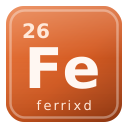
The name is a chemistry joke that got out of hand: Fe, element 26, is iron; Rust is what iron becomes; ferrixd is an IRC daemon written in Rust. The logo is iron's periodic-table tile.
What you get
A single static binary that is:
- A complete IRC server. Registration, channels, modes, topics, WHO/WHOIS, MOTD, LUSERS, MONITOR, LIST — the full classic surface, with consistent
asciiorrfc1459case mapping. - An IRCv3 server. 29 capabilities, including
server-time,message-tags,batch,echo-message,labeled-response,standard-replies,draft/chathistory,draft/multiline, anddraft/metadata-2. Capabilities are implemented against the spec text, not against what other servers happen to do. See the capability reference. - Its own services. Accounts, SASL (
PLAIN,EXTERNAL,SCRAM-SHA-256), account self-registration, and channel registration are built into the daemon — there is no bolted-on NickServ/ChanServ pseudo-server to keep in sync or crash independently. - A federation node. Servers link over mutual TLS with pinned certificate fingerprints and form a multi-hop mesh: cross-server channels, messages, WHOIS, netsplit cleanup, and deterministic nick-collision resolution — no synchronized clocks required. See Federation.
- Extensible, safely. Moderation hooks can be written as sandboxed WASM plugins executed under a fuel budget — a buggy or malicious plugin traps instead of hanging the server. See WASM Plugins.
- Operable. Prometheus metrics, structured tracing,
REHASHhot-reload, a config validator (ferrixd check), and built-in helpers for certificates and password hashes. See Observability.
What makes it different
Memory safety is not negotiable
unsafe_code = "forbid" applies to the entire workspace — not "minimal unsafe", zero. The wire parser, the security-critical hot path, lives in its own dependency-light crate (ferrix-protocol) so it can be fuzzed and audited in isolation. It parses without copying, never panics on hostile input, and CI promotes panic!/unwrap/expect in the data path to build errors.
TLS is the transport, not an option
The primary listener is TLS. A plaintext listener exists for local testing only: binding it to a non-loopback address is a configuration error unless you explicitly set allow_plain_nonlocal = true. Passwords are hashed with Argon2id and verified in constant time; hosts can be cloaked with an HMAC so they are unforgeable.
Designed for hostile networks
Every resource a client can consume is bounded: outbound queues (SendQ), inbound command rate (token bucket), connections per IP, registration time, TLS handshake time, history memory, list-mode entries. Exceeding a bound has a defined, documented consequence — usually disconnection with a reason that shows up in the metrics.
Density as a feature
One async task per connection — not one thread — over a fixed worker pool and sharded shared state. Load-tested to ~100,000 concurrent connections on an 8-core host at ~1.38 GB RSS (~13.8 KB per connection), scaling linearly. The methodology and generator live in the repository's loadtest/ directory.
What it is not
- Not a TS6/legacy-protocol server. The S2S protocol is modern and ferrixd-native (spec here). Linking to charybdis/solanum works through the dedicated TS6 bridge, which translates at the network edge — the native protocol stays legacy-free.
- Not a hosted service. ferrixd is software you run. It has no accounts web portal, no built-in web client.
- Not finished deciding what IRC should be. Draft capabilities (
draft/…) are implemented as drafts and will track the specs as they stabilize.
Where to go next
| You want to… | Read |
|---|---|
| See it run in 60 seconds | Quick Start |
| Install it properly | Installation |
| Configure a real server | Configuration |
| Link two servers | Federation |
| Look up an exact flag, cap, or limit | Reference |
| Understand how it's built | Architecture |